
Turning invasive seaweed into a valuable resource for sustainable sea urchin aquaculture
Rugulopteryx okamurae is a brown macroalga native to the Northwest Pacific that has become a highly invasive species across Europe. It aggressively colonises rocky seabeds in the Mediterranean Sea and along the Portuguese coast, displacing native communities and disrupting marine ecosystems. The species also has considerable socio-economic impacts, affecting fisheries and tourism. Its commercial value remains very limited due to the presence of toxic diterpenes and its pungent taste, restricting its potential use mainly to pharmaceutical or cosmetic applications.

Fig. 1- Deposition of invasive seaweeds (R. okamurae) on the beaches of southern Portugal. Source: Barlavento (Diário do Algarve) https://www.barlavento.pt/
One of the objectives of the AQUAFISH 0.0 project is to promote circular economy principles and a zero-waste approach by creating value from underutilised marine resources, including invasive seaweeds. Within this framework, the EPPO team developed a formulated feed for the edible sea urchin Paracentrotus lividus, incorporating R. okamurae as one of its main ingredients. The feed was developed in collaboration with SPAROS R&D, a company based in Olhão, southern Portugal, while the invasive seaweed biomass was collected by Easy Harvest, an Algarve-based blue economy start-up specialising in the monitoring, mitigation and valorisation of harmful seaweed blooms.
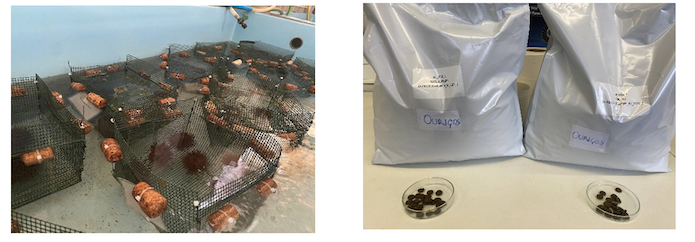
Fig. 2- Trial production of sea urchins (left) and inert feed made from invasive seaweed produced in IMTA (right)
The research was conducted in two pilot trials.
In the first trial, four different diets were evaluated:
- Dried Ulva sp. produced in the EPPO Integrated Multi-Trophic Aquaculture (IMTA) system;
- Dried Rugulopteryx okamurae collected from the southern Portuguese coast;
- A formulated feed containing 20% Ulva sp.;
- A formulated feed containing 10% R. okamurae and 10% Ulva sp.
The second trial, which is still ongoing, compares three formulated diets:
- 10% R. okamurae + 10% Ulva sp.;
- 20% Ulva sp.;
- 20% R. okamurae.
Results from the first trial demonstrated that sea urchins readily accepted all four diets, and no diet-related mortality was observed. However, their biological performance differed substantially among treatments. Sea urchins fed exclusively with dried R. okamurae showed neither somatic growth nor gonad development, whereas the highest growth rates and gonad production were achieved with the formulated feeds.
Biochemical analyses further revealed the remarkable ability of P. lividus to concentrate proteins in the gonads (over 50%), regardless of the diet consumed. Although R. okamurae has a superior nutritional profile compared with Ulva species, its use as a sole diet proved ineffective because sea urchins were unable to assimilate its nutrients. This limitation is attributed to the presence of secondary metabolites, such as dilkamural, which induce toxicity and metabolic inhibition.
In contrast, when R. okamurae was processed and incorporated into a formulated feed, these negative effects were effectively neutralised. The mixed formulated diet produced the best overall performance, promoting both superior somatic growth and enhanced gonad development. These findings are described in the MSc thesis entitled "Valorization of the invasive algae Rugulopteryx okamurae in the blue economy: food resource or hazard in Paracentrotus lividus aquaculture", completed within the Master's Programme in Marine Resources at NOVA University Lisbon.
The second phase of the study aims to evaluate a new feed formulation containing 20% R. okamurae without the inclusion of Ulva sp. The ultimate goal is to support the future commercial production of sustainable sea urchin feed based primarily on an invasive seaweed with no current commercial value, contributing to both environmental management and the development of a circular blue economy.
AQUAFISH 0.0 is a project funded by ERDF through the INTERREG Atlantic Area 2021-2027 programme (project code EAPA_0062/2022).